
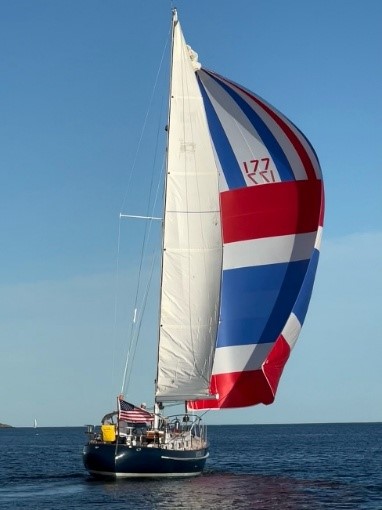
My interest in this industry has been life-long. I grew up boating with my folks on our wooden 36′ fly-bridge Novi. I started sailing in the 80’s and then raced my J24, Catch 22 (foreground blue boat) for 23+ years. She was a 1977 hull number 22 of the over 6,000 J24s built. Much work was done to keep her looking young and sailing fast.
I’ve been working the marine industry for over thirty years in the capacity of a yacht rigger, yard manager and service manager. My survey clients appreciate that I’m not only able to identify a potential issue with a vessel but also offer proven advice on methods and materials to repair or maintain it. It’s not uncommon for a boat owner to call me years after I saw their boat to run a repair scenario by me that we talked about when we did their survey. I welcome and enjoy those conversations and the opportunity to help.
Please visit the “Valiant Restoration” page to see some of the many project ongoing on my current boat. I think you’ll see how my experience can be of service to you. “I apologize in advance for the extent of detail that’s coming next.”
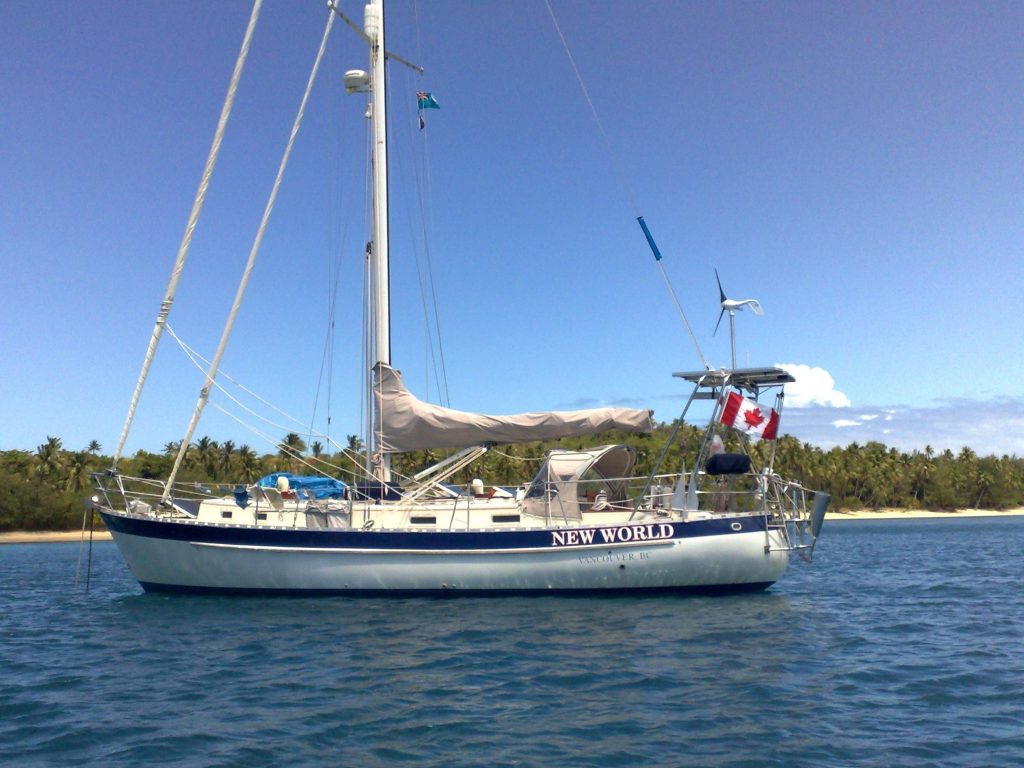
The Valiant 40 Restoration Project
In 1984 I was doing some work on a boat that my wife and I ultimately chartered for our honeymoon. We left Beverly and sailed up the coast of Maine and enjoyed three weeks of blissful cruising. The vessel was a Robert Perry deigned Valiant Esprit 37. I had been interested in these successful Perry designs since the midseventies and in particular, the 40′ version. The Valiant 40 has a reputation for sea kindly swiftness and they have proven their merit by winning multiple ocean races and safely transporting cruising sailors throughout the world’s oceans. Suffice to say, by the end of the honeymoon, I was drinking the Valiant Kool Aid.
Fast forward to 2008:
Good news: I finally found a 1977 Valiant 40 I could afford.
Bad news: She was very needy. Amulet was built during the infamous “fire retardant resin era” of the Valiant history (blue water boat.org). In addition to having the unsightly but non structure blistering, resulting from the fire-retardant resin; she had been badly let go. Water had intruded the Balsa deck core in so many places that the entire top layer of the deck had to be completely removed and all the Balsa core beneath it. Nothing was spared including, the side and fore deck, cabin top, cockpit sole and cockpit seating areas.
All these areas were re-cored with Core Cell set in thickened epoxy and covered by 2 layers of 1708 biaxial fiberglass cloth. A final layer of 18oz boat cloth was laid on top and then vacuum bagged down to facilitate bonding. In the process, the head sail tracks were recessed into the core of the side decks; along with the middeck drains. The cockpit had a large raised propane locker behind helms seat, limiting where one could sit. This has been removed and a plug was taken from another locker top. Now a new locker was created and making a flush seat for the helmsman that, when opened, offers clear access to the new steering radial and wire below. The large propane locker was then cut in two and reused. Each part became the new propane boxes that contained drains in the “corners” of the canoe stern with custom locker lids made for them.
The mast system was upgraded with new rod rigging and the mast was rewired and painted. New chain plates we waterjet cut to reduce stress on the metal and polished to resist pitting over time. The sails are mixed but the main is new.
Her bottom was sand blasted and re-faired with thicken epoxy. Her rudder had some voids so it was removed, pealed, re-glassed with epoxy and is good as new.
She had a 1999 Beta Marine 43 diesel engine that was started once a year over the ten-year refit. But once launched the transmission and gear needed rebuilding and a new shaft, cutlass bearing, and stuffing box was installed.
She now has a full suite of B&G electronic including Zues 3 plotter, HALO 20 Radar, Auto Pilot, Triton depth, wind and boat speed, AIS, boat base computer, VHF, and Starlink
😊 She is Not for Sale 😊
If you think I’m qualified to look at your boat, please call for an appointment
Many Thanks,
Joe Grenier
978-317-5670